
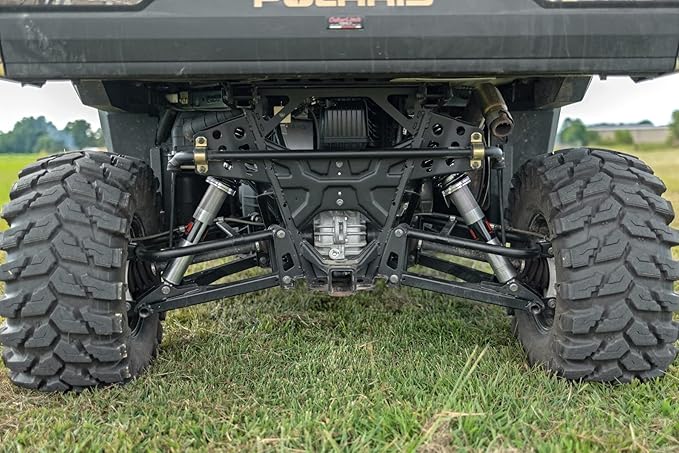
Polaris Ranger 1000 Suspension & Steering Maintenance Guide
A Ranger’s ride quality, straight-line tracking, and ground-hugging traction all depend on friction-free pivots and a correctly pre-loaded suspension. Skip a few grease sessions or let the shocks sag and you’ll feel every rut, fight wandering steering, and wear tires early. The good news: Polaris builds in easy-access zerks and a simple cam system so one afternoon with a grease gun and spanner can restore showroom handling.
Polaris Ranger 1000 Service Rhythm (factory guidance)
- Before every ride
- Turn the wheel lock-to-lock; steering should sweep smoothly with no clunk.
- Quick-scan upper-/lower A-arms and tie-rods for cracked boots or missing cotter pins.
- After every deep-wash or water crossing
- Grease all suspension zerks immediately to chase out water and avert rust.
- Every 200 hrs / 2,000 mi (yearly)
- Pump fresh grease into every pivot and sway-bar bushing.
- Inspect tie-rod ends, wheel bearings, ball joints, and bushings; replace anything loose or rough.
- Severe-use riders (mud, sand, heavy payload): halve all hour/mile figures above.
Polaris Ranger 1000 Grease-Point Walk-Around
(Shop rag + premium all-season grease)
- Front A-arms – 2 zerks each arm; wipe nipple first, pump until a dab squeezes past the seal.
- Rear A-arms – mirror the front: 2 zerks per arm.
- Sway-bar bushings – one zerk on each D-bushing under the cargo bed; two shots is plenty.
- Prop-shaft U-joints – not suspension, but easy to reach while you’re under there.
Tip: If the gun plunger fights back, pivot may be bone-dry—keep squeezing until fresh grease purges dirty sludge.
Polaris Ranger 1000 Shock-Cam Preload Adjustment
Polaris ships the Ranger 1000 shocks on the softest cam notch; that’s perfect for trail play and light hauling. When you start loading seed bags or tow a log splitter, bump the cam up a click or two:
- Lift the axle just enough to unload the spring.
- Insert the hooked spanner (or a drift punch) and rotate the cam clockwise to stiffen, counter-clockwise to soften.
- Match settings side-to-side; unequal preload skews ride height and pulls the machine off-line.
- Return to the softest notch after the cargo is gone—Polaris warns a raised ride height hurts stability when empty.
Polaris Ranger 1000 Ball-Joint & Bushing Check
- Jack and secure the corner; grab the top and bottom of the tire.
- Rock in-out: more than ⅛ in. play = worn ball joint or hub bearing.
- Rock fore-aft: clunk here points to tie-rod ends.
- Visual: split boots, weeping grease, or rust trails signal impending failure—replace before it lets go on the trail.
- On re-assembly, torque wheel nuts to spec and re-check steering sweep for smoothness.
Quick Fixes & Troubleshooting
- Squeak over every bump? Dry A-arm pivots—grease until silent.
- Machine sags when you hook up the trailer? Add one cam click rear, two max; anything more, upgrade to heavy-load springs.
- Steering drifts left or right on flat ground? First inspect ball joints/tie-rods, then verify both shock cams sit on the same notch.
- Clunk on throttle chop? Likely prop-shaft U-joint play—grease now, replace if noise remains.
Recommended Reading
- Polaris Ranger 1000 Maintenance Schedule: The Complete Schedule
- Polaris Ranger Oil Change Guide: Step-by-Step Service for Your Ranger 1000
- Polaris Ranger Air Filter Maintenance: The Dust-Proof Guide for Ranger 1000 Owners
- Polaris Ranger Brake Maintenance: Trail-Ready Braking Power
Ready to Wrench?
Grab genuine Polaris grease, a hooked spanner, and any worn ball-joint replacements. Lube every pivot, fine-tune your shock cams, and enjoy factory-fresh handling on your very next ride.
FAQS
How often should I grease the suspension zerks on my Polaris Ranger 1000?
- Before every ride: Do a quick visual check for torn boots or missing cotter pins.
- After any deep wash or water crossing: Grease all suspension zerks immediately to push out moisture and prevent rust.
- Every 200 hours / 2,000 miles (or yearly): Pump fresh grease into every A-arm pivot, sway-bar bushing, and prop-shaft U-joint until clean grease purges. If you ride in mud, sand, or haul heavy loads, cut those hour/mile intervals in half.
When and how should I adjust the shock-cam preload on a Polaris Ranger 1000?
- The shocks ship in the softest cam notch—ideal for light trail riding. When you add cargo or tow equipment, raise preload one or two clicks:
- Jack the axle just enough to unload the spring.
- Use a hooked spanner (or drift punch) to turn the cam clockwise to stiffen or counter-clockwise to soften.
- Match settings on both sides to maintain even ride height.
- Return to the softest notch after the load is removed, as running with excess preload can reduce stability when the machine is empty.
